
Why Does My Car’s AC Blow Cold Only While Driving?
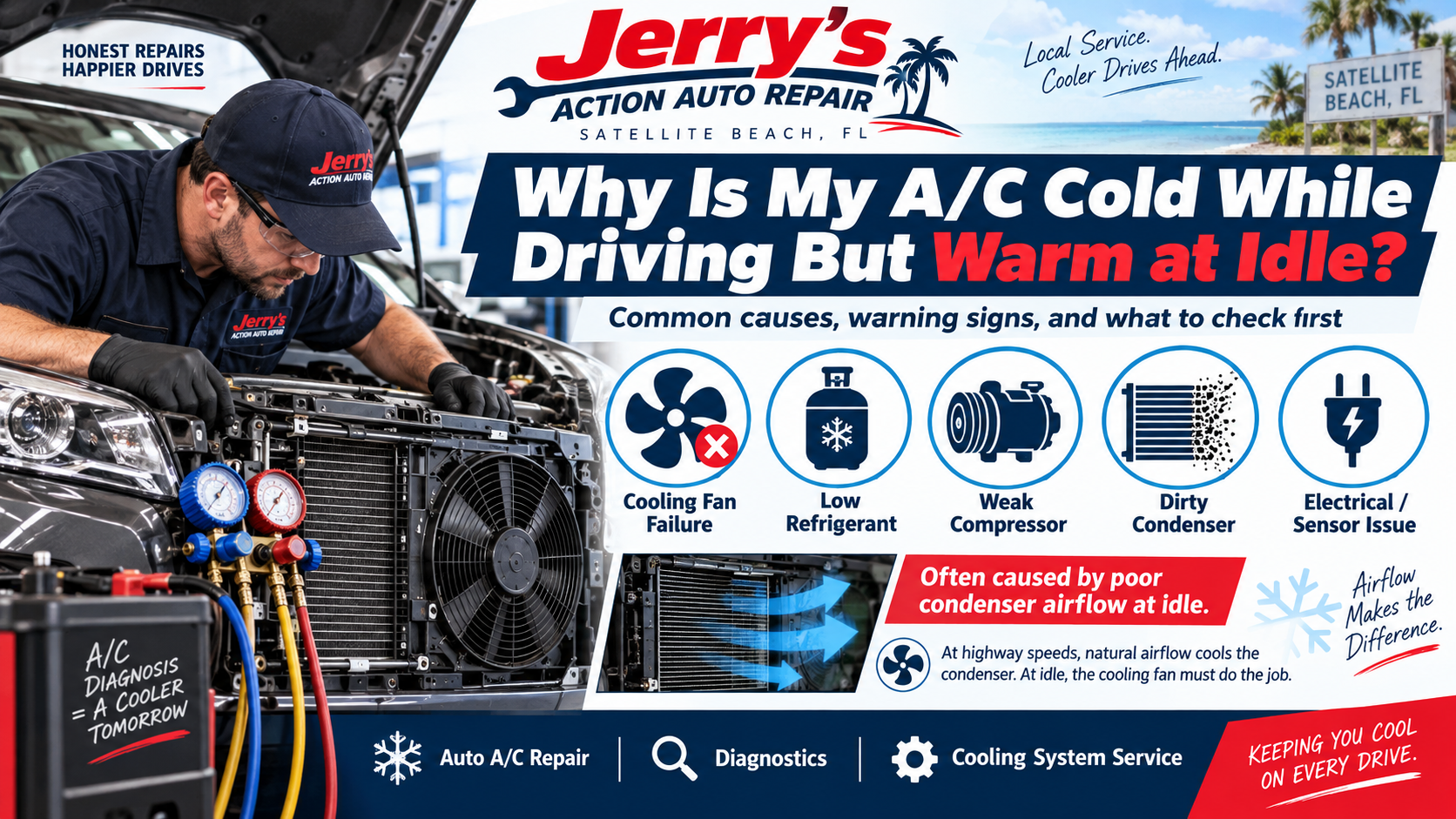
If your car’s air conditioner blows cold while driving but turns warm when you stop at a light or sit in traffic, the A/C system is usually having trouble removing heat when the vehicle is not moving.
The most common cause is a radiator or condenser cooling fan that is not working correctly. While the car is moving, outside air naturally flows through the A/C condenser, carrying heat away. At idle, the electric cooling fan has to create that airflow. If it fails, refrigerant pressure rises, and A/C performance can drop sharply.
Other possible causes include low refrigerant, a weak compressor, condenser restrictions, incorrect refrigerant charge, or electrical problems affecting the fan or compressor.
Jerry’s Action Auto Repair provides car A/C repair in Satellite Beach, FL, for systems that blow warm air, cool inconsistently, cycle excessively, or lose cooling performance at idle.
Why Does My AC Get Colder When I Start Driving?
A car A/C system that gets colder as vehicle speed increases often has an airflow problem at the condenser or an A/C component that performs better at higher engine speed.
Your vehicle’s A/C condenser is located near the front of the vehicle and releases heat absorbed from the passenger compartment.
When the vehicle is traveling down the road, air passes naturally through the grille and across the condenser.
When the vehicle stops, that airflow nearly disappears. Electric cooling fans must take over.
If airflow is inadequate at idle, condenser temperature and refrigerant pressure increase. Once the car begins moving again, natural airflow improves heat transfer, and the vents may quickly become cold again.
That speed-dependent pattern is an important diagnostic clue.
1. Radiator or Condenser Fan Failure
A failed cooling fan is one of the most common reasons an A/C system blows warm at idle but cold while driving.
The condenser needs steady airflow to release heat from the refrigerant.
Most modern vehicles use one or more electric fans behind or in front of the radiator and condenser. Depending on the vehicle, the same fans may cool both the engine radiator and the A/C condenser.
When the A/C is operating, the vehicle’s control system normally commands the fan when needed.
Fan problems can result from:
- Failed fan motors
- Blown fuses
- Bad relays
- Wiring problems
- Failed fan-control modules
- Temperature or pressure sensor faults
Once the vehicle starts moving, road speed can provide enough airflow to compensate for the failed fan.
Jerry’s Action Auto Repair provides electrical system diagnostics for fan motors, wiring, fuses, relays, and other electrical faults that can affect A/C operation.
Can I Check Whether the Cooling Fan Is Working?
With the engine and A/C operating, the cooling fan will normally run when system conditions require it, but fan operation varies by vehicle and should not be diagnosed based on a single observation.
Some vehicles run the fan continuously with the A/C on. Others vary the fan speed or cycle the fan according to refrigerant pressure, engine temperature, and operating conditions.
A fan that never operates despite rising A/C pressure or engine temperature requires further diagnosis.
Do not put your hands, tools, or clothing near an electric fan. Electric cooling fans can start unexpectedly, even when they appear to be off.
A technician can command the fan electronically, check power and ground, test control circuits, and monitor A/C pressure to determine whether the airflow system is operating correctly.
2. Low Refrigerant Charge
Low refrigerant can cause weak A/C performance, which becomes more noticeable at idle because the system has reduced cooling capacity and the compressor runs at a lower speed.
Automotive A/C systems require a specific mass of refrigerant.
If refrigerant is lost due to a leak, the evaporator may not receive enough to absorb heat efficiently.
At higher engine RPM or road speed, the system may temporarily perform better, making the vents feel colder while driving.
Low refrigerant can also cause the compressor to cycle more frequently.
Importantly, refrigerant does not normally get “used up.” If the system is significantly low, there is usually a leak somewhere.
Common leak locations include:
- Hose connections
- Compressor shaft seals
- Condenser damage
- Service-port valves
- Evaporator leaks
- O-rings and fittings
Jerry’s Action Auto Repair’s A/C repair service includes refrigerant level checks, leak diagnosis, recharge service, and component repair as needed.
Should I Just Add Refrigerant?
No. Adding refrigerant without measuring the existing charge can leave the system undercharged or overcharged and may hide an underlying leak.
A/C systems are designed to operate with a specific refrigerant quantity.
Too little refrigerant reduces cooling performance. Too much can increase high-side pressure and reduce condenser efficiency.
Modern vehicles may use R-134a or R-1234yf refrigerant depending on the model and year. The correct refrigerant type and charge quantity are listed on the vehicle’s underhood A/C label.
The proper diagnostic approach is to identify leaks, evaluate system pressures and temperatures, and charge the system to the specified amount.
3. Weak or Failing A/C Compressor
A worn compressor may cool adequately at higher engine speeds but struggle to produce the required pressure difference at idle.
The compressor circulates refrigerant, creating the pressure difference that allows the A/C system to absorb heat inside the cabin and release it through the condenser.
At idle, compressor speed is relatively low.
A worn compressor may no longer pump efficiently enough at that speed. When engine RPM increases, compressor output may improve, and vent temperature may drop.
Depending on the vehicle, the problem can involve:
- Internal compressor wear
- Compressor clutch problems
- A slipping clutch
- Compressor control valve failure
- Electronic compressor-control problems
Many newer vehicles use variable displacement compressors that operate differently from traditional fixed displacement designs. Proper pressure and command-data testing is more useful than assuming the compressor itself has failed.
4. Dirty or Blocked A/C Condenser
A condenser covered with debris or internally restricted cannot release heat efficiently, and the problem can worsen significantly when the vehicle is stationary.
The condenser is located at the front of the vehicle, where it is exposed to:
- Bugs
- Leaves
- Dirt
- Road debris
- Bent cooling fins
Anything that restricts airflow reduces the condenser’s ability to transfer heat.
At highway speed, the greater volume of incoming air may partially overcome the restriction. At idle, airflow may no longer be sufficient.
Internal condenser restrictions can also interfere with refrigerant flow and produce abnormal system pressures.
A visual inspection can identify obvious external blockage, but pressure and temperature measurements may be needed to diagnose an internal restriction.
5. Engine Cooling System Problems
An engine that runs too hot can reduce A/C performance because the condenser and radiator share the same airflow, and the vehicle may reduce compressor operation to protect the engine.
The engine cooling and air-conditioning systems are separate, but they interact closely.
The condenser is normally positioned directly in front of the radiator. Heat rejected by the condenser therefore passes through the radiator area.
If the engine cooling system already has trouble controlling temperature, A/C operation can add additional heat load.
Many vehicles will reduce or disable compressor operation if the engine temperature becomes excessive.
If poor A/C performance at idle occurs along with a rising temperature gauge, coolant loss, or overheating, the engine cooling system should be checked immediately.
Jerry’s Action Auto Repair provides cooling system repair, including radiator service, water pump inspection, thermostat replacement, leak diagnosis, pressure testing, and coolant service.
Why Does My AC Get Warm at Stoplights?
If the A/C turns warm when stopped and then cools again shortly after the vehicle begins moving, inadequate condenser airflow is one of the first conditions to investigate.
At a red light, vehicle speed falls to zero.
Without natural airflow through the front grille, the cooling fans must move air across the condenser.
A fan that is weak, operates at one speed, or does not turn on at all may allow high side refrigerant pressure to rise quickly.
Once you accelerate, outside air flows through the condenser again, and the A/C begins working normally.
That pattern is much more consistent with an airflow or pressure control problem than something like a cabin air filter.
6. Incorrect Refrigerant Charge or Excessively High System Pressure
An overcharged A/C system or one containing air or other non-condensable gases can develop excessively high side pressure, particularly at idle.
Refrigerant must condense from a high-pressure vapor into a liquid before continuing through the system.
If the system contains too much refrigerant or contamination prevents proper heat transfer, the condenser pressure can become excessively high.
Road-speed airflow may lower pressure enough to help the system cool better while moving.
At idle, pressure can climb again, and cooling performance may fall.
Some vehicles will even disengage the compressor when pressure exceeds a safe limit.
This is another reason A/C systems should be charged according to specifications rather than simply adding refrigerant until the vents feel colder.
7. Compressor Clutch Problems
On vehicles with a conventional compressor clutch, excessive clutch wear or incorrect air gap can cause intermittent compressor engagement and inconsistent cooling.
When the A/C is requested, the clutch engages the compressor pulley with the compressor shaft.
As components wear, the clutch may begin to slip or fail to engage reliably— especially when the system becomes hot.
Symptoms may include:
- A/C suddenly becoming warm
- Cooling returning after engine speed changes
- Intermittent compressor engagement
- Clicking or unusual noises
- Compressor cycling unexpectedly
Not every modern compressor uses a conventional cycling clutch, so diagnosis depends on the specific vehicle.
8. A/C Pressure Sensor or Electrical Control Problem
Incorrect pressure sensor data or an electrical control fault can prevent the cooling fan or compressor from operating when needed.
Modern A/C systems depend heavily on electronic controls.
The vehicle may use refrigerant pressure sensors, ambient temperature sensors, evaporator sensors, control modules, relays, and electronic compressor controls.
If one of these systems sends incorrect information, the computer may command the fan or compressor incorrectly.
This is where professional vehicle diagnostics can be especially useful. A technician can compare sensor values, compressor commands, fan commands, and refrigerant pressures rather than replacing components based on symptoms alone.
Could a Bad Cabin Air Filter Cause This?
A clogged cabin air filter can reduce airflow from the vents, but it usually does not explain why the A/C is warm only while stopped but cold while driving.
The cabin filter removes dust, pollen, and debris from air entering the passenger compartment.
When severely clogged, it can reduce the amount of air coming through the vents.
However, the restriction remains whether the vehicle is moving or stationary.
If air volume is consistently low, the cabin filter or blower system deserves attention.
If airflow remains strong but the air temperature changes with vehicle speed, the problem is more likely related to refrigerant pressure, condenser airflow, or compressor performance.
Could the Blower Motor Cause AC to Work Only While Driving?
Usually not. A blower-motor problem affects the amount of air leaving the vents rather than the refrigerant’s ability to cool that air.
If the blower fan stops, slows down, or operates only on certain settings, the problem may involve the blower motor, resistor, control module, wiring, or HVAC controls.
But if the fan blows strongly at idle and the air itself becomes warm, the issue is probably elsewhere in the A/C system.
Separating weak airflow from warm airflow is an important first diagnostic step.
Why Is My AC Cold on the Highway but Warm in City Traffic?
Highway speed provides significantly more airflow through the condenser than low-speed traffic, so a marginal fan, condenser, compressor, or refrigerant problem can be masked at higher speeds.
This symptom is especially common in hot weather.
In slow traffic, the A/C system faces several disadvantages at once:
- Little natural condenser airflow
- Lower compressor RPM
- High underhood temperature
- Higher cabin heat load
- High outdoor temperature
On the highway, airflow increases dramatically, and engine RPM often rises.
A marginal system may therefore appear perfectly normal until the car slows down again.
Is It Safe to Drive With AC That Only Works While Moving?
The A/C problem itself may not immediately make the vehicle unsafe, but a failed cooling fan can also cause engine overheating and should not be ignored.
If the same electric fan cools both the A/C condenser and engine radiator, fan failure can eventually affect engine temperature—particularly during extended idling or slow traffic.
Watch the temperature gauge closely.
If the engine temperature rises above normal, an overheating warning appears, or steam is visible, stop driving and address the cooling system problem.
Even if engine temperature remains normal, inconsistent A/C operation indicates a fault that should be diagnosed before additional components are damaged.
How Is This A/C Problem Diagnosed?
Diagnosis involves comparing A/C performance at idle and at higher RPM while checking refrigerant pressures, condenser airflow, cooling fan operation, compressor control, and vent temperature.
A technician may check:
- Vent temperature
- Refrigerant pressure
- Refrigerant charge
- Cooling fan operation
- Fan electrical circuits
- Compressor operation
- Compressor commands
- Condenser airflow
- Refrigerant leaks
- Temperature and pressure sensor data
The relationship between high-side pressure and condenser airflow is especially useful when the complaint occurs primarily at idle.
If pressure rises abnormally while stationary and falls when airflow increases, the technician can focus the diagnosis on the components responsible for rejecting heat.
Car AC Repair in Satellite Beach, FL
If your A/C blows cold on the highway but warm at stoplights, the system is giving you a useful diagnostic clue.
A failed cooling fan is a common cause, but low refrigerant, a weak compressor, condenser restrictions, incorrect refrigerant charge, and electrical control problems can produce similar symptoms.
Jerry’s Action Auto Repair provides auto A/C repair in Satellite Beach, along with vehicle diagnostics, electrical system repair, and cooling system service for drivers in Satellite Beach, Melbourne Beach, Cocoa Beach, and surrounding Brevard County communities.
Finding the cause early can restore consistent cooling and prevent a minor airflow or refrigerant problem from developing into a larger repair.
Frequently Asked Questions
Why does my car’s AC only get cold when I accelerate?
Higher engine speed can increase compressor output, while increased vehicle speed improves airflow through the condenser. A weak compressor, low refrigerant charge, or condenser airflow problem can therefore become less noticeable during acceleration.
Why does my AC blow warm when I’m stopped?
A failed or weak radiator/condenser cooling fan is a common cause. Without vehicle movement, the fan must provide the airflow needed to remove heat from the A/C condenser.
Can low refrigerant cause the AC to be warm at idle?
Yes. An undercharged system may have reduced cooling capacity and can perform especially poorly at low compressor speed. Because refrigerant loss generally indicates a leak, the system should be inspected rather than repeatedly topped off.
Can a bad radiator fan affect the air conditioner?
Yes. The A/C condenser requires airflow to release heat. If the cooling fan does not operate at low vehicle speeds, condenser pressure can rise, and vent temperature can increase.
Why does my AC work better on the highway?
Highway driving forces much more air through the condenser and often increases compressor speed. That can temporarily compensate for a weak fan, restricted condenser, low refrigerant charge, or marginal compressor.
Does a clogged cabin air filter make the AC warm at idle?
Usually not. A clogged filter primarily reduces the volume of air coming from the vents. If airflow remains strong but the vehicle becomes warm when the vehicle stops, the cause is more likely related to condenser airflow or refrigerant system performance.
Does my car need an AC recharge if it only cools while driving?
Possibly, but not necessarily. Low refrigerant is only one possible cause. Fan failure, condenser restrictions, compressor problems, excessive pressure, or electrical faults can produce the same symptom.
Can this problem cause my engine to overheat?
It can if the underlying problem is a cooling fan that also serves the engine radiator. If the engine temperature rises while the vehicle sits in traffic, the cooling system should be inspected promptly.